
Eelah Neurology
NEUROLOGY EDUCATION
For Epilepsy Fellowship Programs
A complete EEG curriculum for epilepsy fellowship programs.
Four progressive training levels. 42 EEG patterns. 672 board-style questions — every one required. Interactive EEG interpretation. Randomized assessments. And a Program Director’s Dashboard that shows exactly where every fellow stands. Not another EEG resource — a complete system for teaching, assessing, and tracking EEG education.
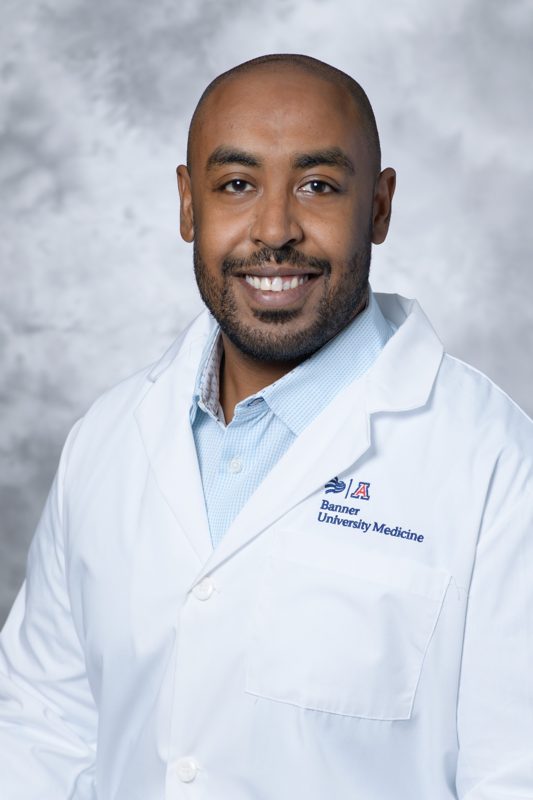
Eelah Neurology was developed by Sagi Elhassan, MD — ABPN board-certified neurologist, University of Arizona faculty member, practicing neurohospitalist, and epilepsy fellow. The curriculum reflects the practical demands of neurological training: recognizing patterns, interpreting findings, applying knowledge, and developing sound clinical judgment — created for the residents and faculty responsible for the next generation of neurologists.
NEUROLOGY: EDUCATION · 2026
“EEG interpretation is a core neurology competency, but instruction and supervised review vary across programs.” Reviewing the online EEG platforms trainees actually use, the authors found that only 1 of the 15 platforms reviewed reports trainee progress to the program director.
NEUROLOGY · 2021 · SURVEY OF US PROGRAM DIRECTORS
Surveying US adult neurology residency program directors, Nascimento and Gavvala found 64% did not utilize objective measures to assess EEG milestones — and the requirements for completing an EEG rotation varied significantly from program to program.
These studies document the gaps in EEG education; they do not evaluate Eelah. That is what the complimentary pilot is for — your program's own data, on your own trainees.
Pilot period: January—June 2027 · Enrollment closes June 16, 2027
Apply for the pilotNormal awake background, drowsiness, sleep stages, mu rhythm, POSTS, lambda, photic driving — and the complete artifact set. Learn to tell brain from not-brain first.
Expected outcome: Identify the normal background, sleep features, and common artifacts.
Generalized and focal slowing, temporal spikes and sharp waves, benign variants (BETS, breach rhythm), FIRDA and TIRDA, 3 Hz spike-and-wave, photoparoxysmal responses — plus structured EEG reporting.
Expected outcome: Recognize common abnormalities and construct a structured EEG interpretation.
Periodic discharges (LPDs, GPDs), triphasic waves, the ictal-interictal continuum, electrographic seizures, slow spike-and-wave, EE-SWAS, hypsarrhythmia, and extreme delta brush.
Expected outcome: Distinguish complex epileptiform and periodic patterns.
Continuous EEG, burst suppression, post-cardiac-arrest patterns, seizure detection in the critically ill, sedation effects, and quantitative EEG.
Expected outcome: Recognize seizures, periodic patterns, and the important ICU EEG features.
Fellowship completion requires both halves — the machine and the questions.
Pass each level's randomized EEG test in the Lab — four renditions of every tracing, so there is nothing to memorize but the medicine. Each level passed earns its certificate of educational completion and unlocks the next.
Work through all 672 questions in Spike & Wave — classification, syndromes, genetics, medications, status epilepticus, surgery, autoimmune, and more. Accuracy is tracked in your dashboard; completion is the standard.
The outcomes above are learning objectives — what a fellow is expected to be able to do after completing each level, and what its assessment measures. They are educational objectives, not a certification of clinical competency.
A structured curriculum without restructuring your fellowship.
The program director enrolls fellows and assigns their starting level.
Fellows complete assigned lessons, atlas material, and interactive EEG exercises.
Fellows apply concepts during supervised EEG review and clinical teaching sessions.
Fellows complete randomized level examinations and receive performance feedback.
The director reviews progress, identifies educational gaps, and assigns additional learning where appropriate.
Eelah structures the learning. Your faculty provide the clinical teaching and supervision.
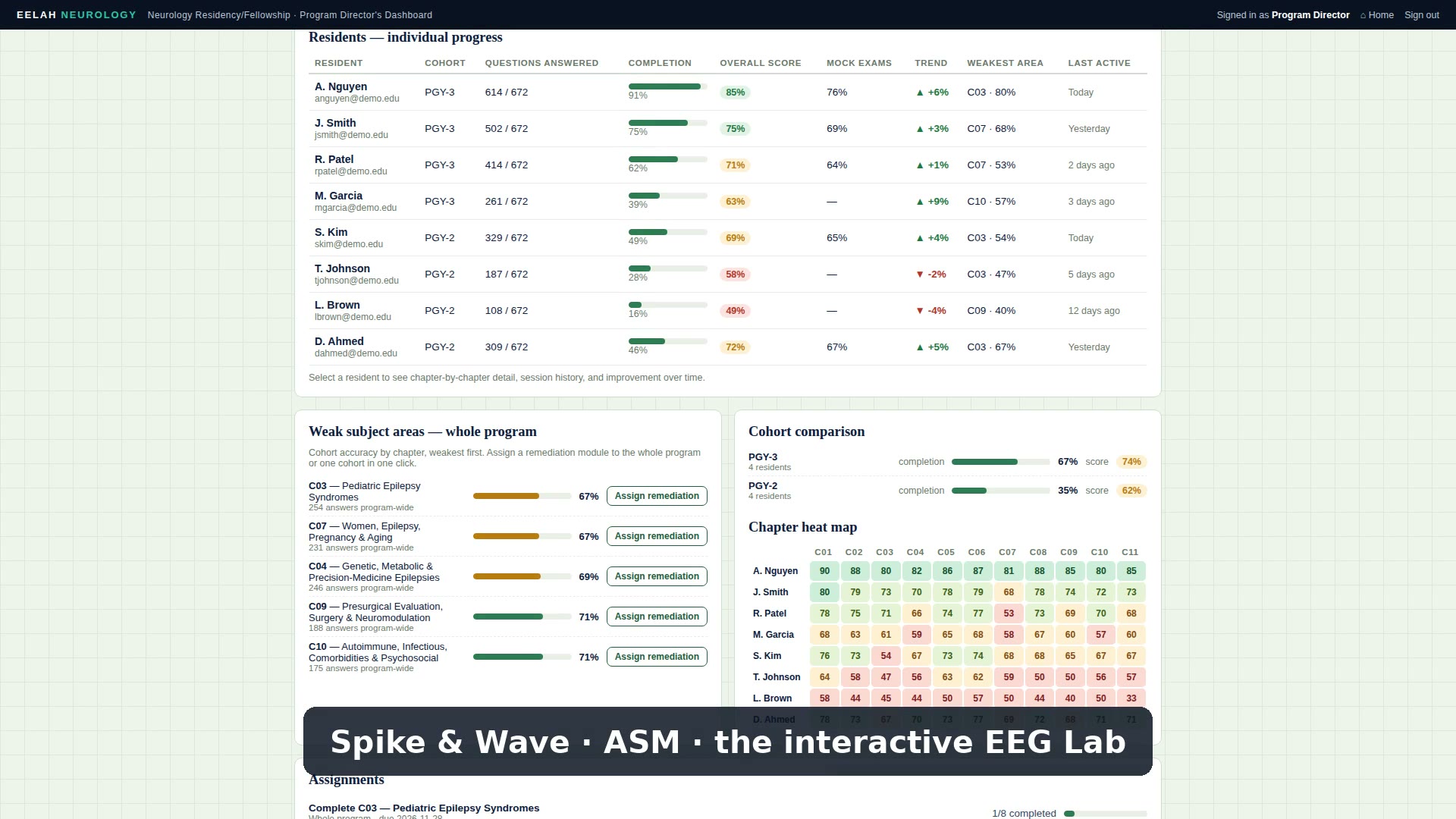
The Program Director's Dashboard — watch it work, 85 seconds.

EEG education often depends on which attending a fellow happens to work with, how busy the service is, and how many interesting cases happen to arrive during a rotation. Eelah gives every fellow the same structured curriculum, the same learning objectives, and the same standardized assessments. One curriculum. One progression framework. Consistent expectations across the entire class.
No assembling teaching slides, pattern libraries, reading assignments, practice questions, assessments, and progress reports on your own time. Eelah provides the educational structure, content, interactive practice, and assessment framework — so faculty can focus on teaching, case discussion, and clinical supervision.
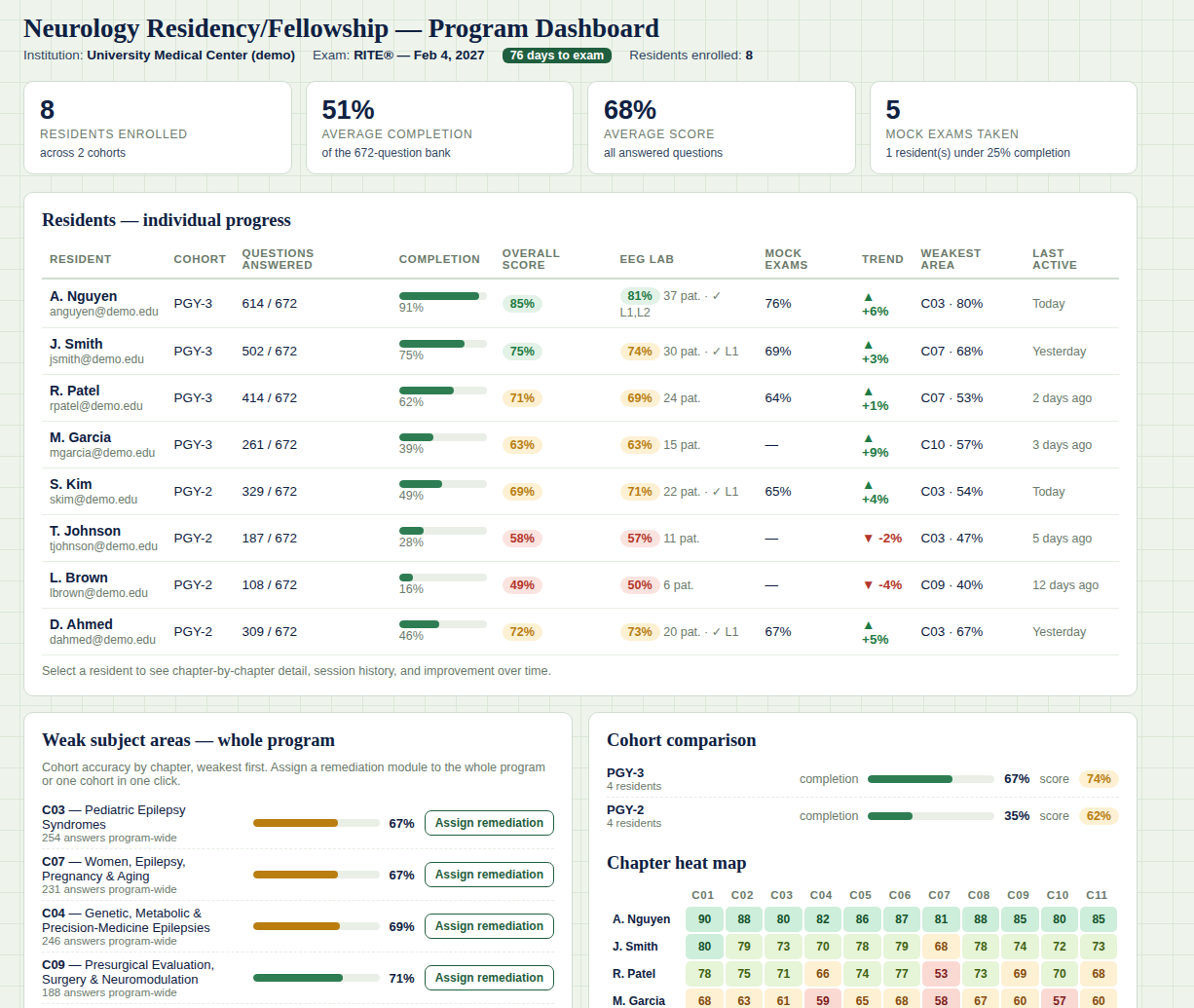
The dashboard shows where each learner is struggling — by chapter and by pattern — while there is still time to teach. It identifies educational weaknesses that guide further instruction; it does not predict clinical performance.
Every level ends with a randomized assessment, and fellows must demonstrate sufficient performance before progressing. Four renditions of every tracing mean the test measures recognition — not memorization of a specific screenshot.
Curriculum participation, completion, assessment performance, strengths and weaknesses, longitudinal progress, and remediation assignments — documented per fellow. The reports support the Clinical Competency Committee’s review; they do not replace faculty evaluation or determine ACGME milestones.
From enrollment to educational progression — what happens when your program adopts Eelah.
Fellows receive access under the institutional license.
They complete lessons, EEG Lab exercises, and corresponding questions.
Randomized assessments measure performance at the end of each level.
Individual and cohort reports show completion, performance, and educational gaps.
Remediation assignments and supervised teaching address identified weaknesses.
Eelah structures the education. Faculty supervise the clinical development.
One institutional package provides every enrolled fellow with the complete EEG Boot Camp, the interactive EEG Lab, the question bank, the pattern atlas, and the learning resources — while giving program leadership a centralized view of educational progress.
Every enrolled fellow gets the complete system — the EEG Boot Camp, the interactive Lab, the question bank, the pattern atlas, and the companions.
Enroll by email from the dashboard; fellows sign in and start at their assigned level — no setup on their side.
Completion, scores, and weakest areas — per fellow and across the cohort — exported for your committee’s review.
Print copies of the books for a class, a rotation, or an EEG lab — every copy includes its online edition for the reader who claims it.
A single contact for program directors and coordinators, with itemized paperwork for education-fund reimbursement.
Tell us your cohort size and we’ll reply with a quote.
or email support@eelahneurology.com directly.
A limited number of programs — 15 residency and 4 fellowship — will pilot the full package from January through June 2027 at no cost, with dedicated onboarding, in exchange for structured feedback. No obligation to purchase afterward. Enrollment closes June 16, 2027 — tell us where to send the invitation.
The curriculum is self-paced and designed to fit inside an existing EEG rotation. Fellows work independently between supervised reading sessions, and each level test is a single sitting covering that level’s patterns.
Cohorts of any size — enrollment is by email from your dashboard. The complimentary pilot (January–June 2027) is limited to 15 residency and 4 fellowship programs; enrollment closes June 16, 2027.
The institutional pilot (January–June 2027) is free. Institutional licensing follows from the 2027 academic year, priced by program — request a quote and we’ll reply with numbers for your cohort size.
Nothing to build. Faculty enroll fellows, review the dashboard, and assign remediation where the data points. Clinical teaching and supervision stay exactly where they belong — with your faculty.
No. Eelah certificates document educational completion of each level. Milestone determinations remain with your faculty and Clinical Competency Committee — the dashboard gives them documented evidence to work from.
Your program sees its own fellows’ educational progress — completion, scores, and activity inside Eelah. Certificates are verifiable by ID on this site. Trainee data is used to run your program’s education reporting, nothing else.
The books, the EEG Lab, and the Boot Camp above all come from one imprint — and one author.
Dr. Elhassan is a practicing neurohospitalist, which entails dealing with acute neurological injuries — including stroke, seizures, status epilepticus, and neuromuscular emergencies.
Board certified in neurology by the ABPN, he is a neurohospitalist and faculty member at the University of Arizona, and an epilepsy fellow. He reads EEG in the epilepsy monitoring unit and teaches the residents and fellows who sit for the same boards these books are built for.
Eelah Neurology is his imprint, based in Tucson, Arizona. The medication content is checked against FDA prescribing information, and the EEG content against current guidelines and ILAE terminology, before it ships.
Why Eelah exists. He built the question bank he wanted for the epilepsy boards because it did not exist: books that test the way the examination does, with vignettes that end in a decision, explanations that say why each wrong answer is wrong, and one key point to carry away from every question.